What's New in clearPath: The Q2 2026 Release
This is the largest clearPath release we have ever shipped — a brand-new responsive dashboard, a Report Builder you drive yourself, private survey invitations, audit scheduling and live coverage heatmaps, Teams and Slack notifications, secure report delivery, Regions, Observation Notes, and a hardened security stack. Here is a guided tour of everything that changed.
Read Full Article →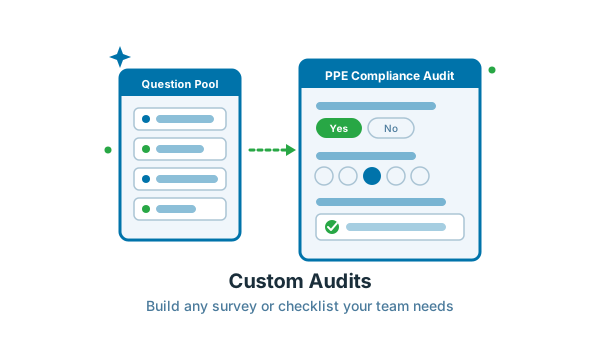
Custom Audits: Build Any Survey or Checklist Your Team Needs
Hand hygiene is where most infection prevention programs start, but rarely where they end. clearPath Custom Audits let you build PPE, environmental services, medication safety, and patient safety audits from reusable questions and response sets — score them automatically, control access by role, and distribute them as public or private surveys, all feeding the same reports and dashboards as your hand hygiene data.
Read Full Article →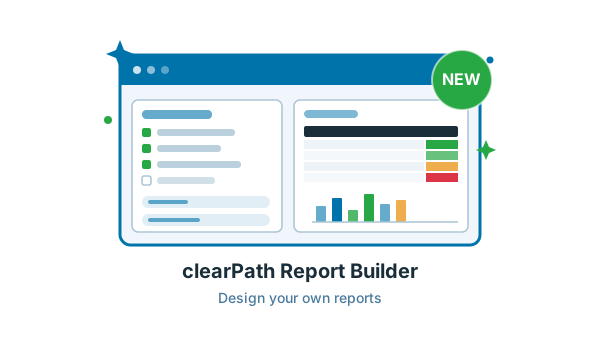
clearPath Report Builder: Design Your Own Reports
The report you need that day is almost on the list, but not quite — a column in a different order, one extra filter, a chart instead of a table. The new Report Builder closes that gap. Pick a dataset, choose and reorder columns, filter and multi-column sort, add totals and colour, drop in a chart, and lay out a header and footer — all with a live preview — then output to PDF, HTML, CSV, Excel, or Word.
Read Full Article →
How to Decrease Infection Rates Using Custom Audits
CLABSI, CAUTI, VAP, and SSI together account for more than 80% of all hospital HAIs — and all are largely preventable. The organizations that consistently achieve the lowest infection rates share one discipline: they design targeted custom audits for their highest-risk processes, close the feedback loop fast, and re-measure. Here is what the evidence shows.
Read Full Article →
Why Direct Observation Hand Hygiene Data Collection Is Critical in Acute Care and Long Term Care
Every day in the United States, approximately 1 in 31 hospital patients has at least one healthcare-associated infection. The single most effective intervention to prevent these infections is hand hygiene. But measuring whether it actually happens requires direct observation — the gold standard endorsed by the WHO, CDC, and Joint Commission.
Read Full Article →
The Impact that Hand Hygiene Rates Have on Infection in Acute Care Facilities
A 10% improvement in hand hygiene compliance produces a 6% reduction in healthcare-associated infections and a 14% drop in C. difficile rates. Yet most acute care facilities operate at compliance levels below 40%. Here is what the evidence shows — and what it means for your infection prevention program.
Read Full Article →
The Top Five Things You Can Do to Improve Hand Hygiene Rates in Your Organization
Adding a single ABHR dispenser per room can raise compliance by 18 percentage points overnight. Structured audit-and-feedback programs have driven an 82% increase across 45 trials. Here are the five evidence-based interventions that move the needle most — and why doing them together matters.
Read Full Article →
How Does C-Suite Buy-In Affect Hand Hygiene Rates?
In a global survey of 3,200+ healthcare facilities, Institutional Safety Climate — the domain capturing leadership commitment — was the single lowest-scoring element of the WHO hand hygiene strategy. Here is what the evidence says leadership must actually do.
Read Full Article →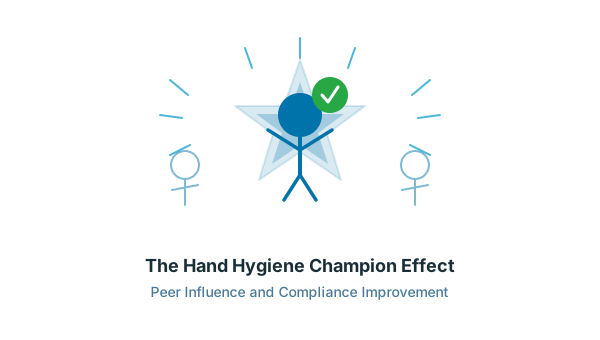
What Impact Does a Hand Hygiene Cheerleader Have on Compliance Rates?
Bundled audit-and-feedback programs — the engine of every champion program — have driven an 82% increase in compliance across 45 trials. But what makes a hand hygiene champion truly effective, and what gets in their way? The evidence may surprise you.
Read Full Article →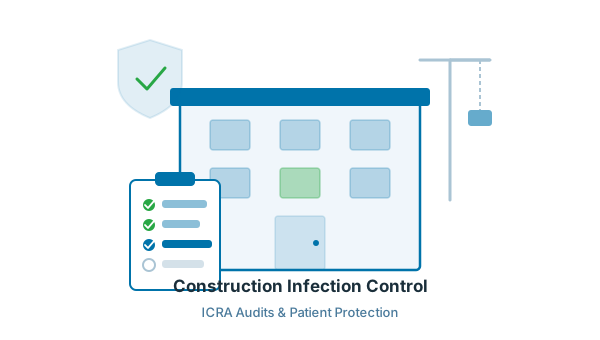
Can Acute Care and Long Term Care Construction Projects Benefit from Custom Audits?
Half of all healthcare-associated Aspergillus outbreaks are linked to construction or renovation activities — with a 50% mortality rate. Yet most facilities rely on a pre-construction ICRA alone, with no structured audit program to verify that precautions are actually being followed throughout the project.
Read Full Article →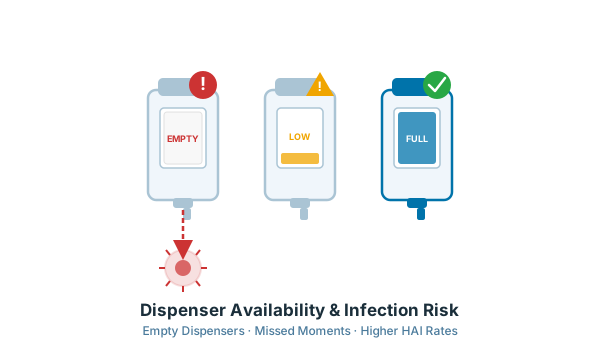
Impact of Empty Dispensers on Infection Rates
One in three healthcare workers cites empty product dispensers as a top barrier to hand hygiene. An empty dispenser does not just reduce compliance — it eliminates the possibility of a compliant event entirely. Here is what the evidence shows about the infection rate consequences of dispenser failures.
Read Full Article →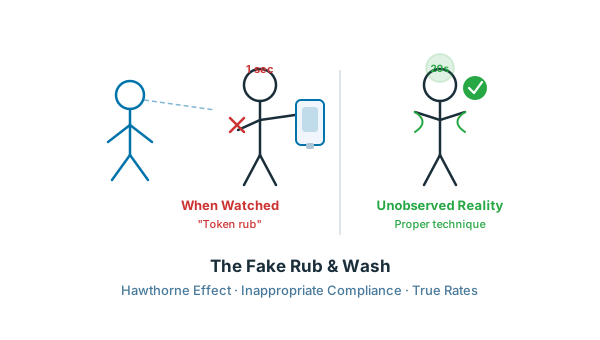
What's the Deal with the Fake Rub and Wash?
When an auditor is present, compliance rates can be 30 percentage points higher than when no one is watching. Electronic monitoring has confirmed that hand hygiene event rates are approximately three times higher near auditors than away from them. Here is what the science of fake compliance reveals — and what to do about it.
Read Full Article →